
Saturday, December 28, 2013
"15 GREAT THOUGHTS BY CHANAKYA"
1) "Learn from the mistakes of others... you can't live long enough to make them all yourselves!!"
2)"A person should not be too honest. Straight trees are cut first and Honest people are screwed first."
...
3)"Even if a snake is not poisonous, it should pretend to be venomous."
4)"There is some self-interest behind every friendship. There is no friendship without self-interests. This is a bitter truth."
5)" Before you start some work, always ask yourself three questions - Why am I doing it, What the results might be and Will I be successful. Only when you think deeply and find satisfactory answers to these questions, go ahead."
6)"As soon as the fear approaches near, attack and destroy it."
7)"The world's biggest power is the youth and beauty of a woman."
"Once you start a working on something, don't be afraid of failure and don't abandon it. People who work sincerely are the happiest."
9)"The fragrance of flowers spreads only in the direction of the wind. But the goodness of a person spreads in all direction."
10)"God is not present in idols. Your feelings are your god. The soul is your temple."
11) "A man is great by deeds, not by birth."
12) "Never make friends with people who are above or below you in status. Such friendships will never give you any happiness."
13) "Treat your kid like a darling for the first five years. For the next five years, scold them. By the time they turn sixteen, treat them like a friend. Your grown up children are your best friends."
14) "Books are as useful to a stupid person as a mirror is useful to a blind person."
15) "Education is the Best Friend. An Educated Person is Respected Everywhere. Education beats the Beauty and the Youth."
1) "Learn from the mistakes of others... you can't live long enough to make them all yourselves!!"
2)"A person should not be too honest. Straight trees are cut first and Honest people are screwed first."
...
3)"Even if a snake is not poisonous, it should pretend to be venomous."
4)"There is some self-interest behind every friendship. There is no friendship without self-interests. This is a bitter truth."
5)" Before you start some work, always ask yourself three questions - Why am I doing it, What the results might be and Will I be successful. Only when you think deeply and find satisfactory answers to these questions, go ahead."
6)"As soon as the fear approaches near, attack and destroy it."
7)"The world's biggest power is the youth and beauty of a woman."
"Once you start a working on something, don't be afraid of failure and don't abandon it. People who work sincerely are the happiest."
9)"The fragrance of flowers spreads only in the direction of the wind. But the goodness of a person spreads in all direction."
10)"God is not present in idols. Your feelings are your god. The soul is your temple."
11) "A man is great by deeds, not by birth."
12) "Never make friends with people who are above or below you in status. Such friendships will never give you any happiness."
13) "Treat your kid like a darling for the first five years. For the next five years, scold them. By the time they turn sixteen, treat them like a friend. Your grown up children are your best friends."
14) "Books are as useful to a stupid person as a mirror is useful to a blind person."
15) "Education is the Best Friend. An Educated Person is Respected Everywhere. Education beats the Beauty and the Youth."


Sunday, December 1, 2013
"How to Handle Being Overloaded and Overworked"
If it seems like you're always stretched too thin and never have enough time to complete your work before three new projects are handed down to you - always with the instructions that they're high-priority - you probably need to talk with your manager about your workload. But with more companies expecting people to do more with less, how can you talk about this in a way that your manager will listen to? Here are five steps to talking to your manager when your workload is overwhelming.
1. Don't assume that your manager knows how high your workload is. Your manager can't help you if she doesn't realize that there's a problem. A common mistake in this situation is to assume that your workload is so obviously high that there's no way that your manager doesn't know, and so therefore she must not care or can't do anything about it. But in reality, you're the person paying the most attention to your workload, not your manager - and she may assume that since you're not speaking up, there isn't a problem. So?
2. Talk to your manager about the situation. Pick a time when your manager isn't rushed and ask to talk about your workload. Explain that it has become unmanageable and why (for instance, that you've taken on the responsibilities of someone who left without anything being removed from your plate, or that a particular account has doubled in size in the last year). Explaining what's behind the workload increase can help because your manager may not be focused on the facts as you.
Slideshow - 10 awesome office perks
Find yourself on the waiting list for a promotion because you lack a skill set? Sign up for the various programmes on offer to enhance your knowledge and the office will pay for it!
2 / 10 Yahoo Finance India
Share to FacebookShare to TwitterShare to Pinterest
ClosePrevious imageNext image
3. Suggest options. You're most likely to get the help that you need if you come prepared to talk about options. For instance, you might say, "I can do A and B, but not C. Or if C is really important, I'd want to move A off my plate to make room for it. Alternately, I can act as an adviser to Jane on C, but I can't do the work of C myself if I'm also doing A and B."
4. Frame it as a matter of making the best choices. If your manager resists making these kinds of trade-offs, you need to keep pushing the issue. Say, "I hear you that we want it all to get done, but since I'm never going to be able to get to it all, I want to make strategic choices about how I should be structuring my time, and make sure that you and I are aligned on those choices." If your manager won't help you prioritize, then come up with your own proposal for what you will and won't prioritize and ask her to tweak it or OK it.
5. Enforce boundaries. To take on something new when your plate is already full, you need to either get rid of something else or at least push it back. So if a new project comes your way, go to your manager and ask about trade-offs: "If I work on this now, it means that X and Y will have to pushed back by a week. Is that OK to do, or should we put this new work on hold until X and Y are finished first?" Or, "I can do this new project and X, or this new project and Y, but not all three in the time frame we have."
One important note: The above should work with a reasonable manager - and even with a somewhat reasonable manager. If you have a manager who listens to everything here and tells you to just find a way to get everything done, then you're working for a bad manager (or alternately, you aren't working as quickly as others in the position, in which case a good manager might push back). If that's the case, you'll need to be realistic about your circumstances and decide how you want to respond.
Thursday, November 28, 2013
"Banks’ CASA deposits grow 33%: What it means"
India’s banks saw a 33% rise in CASA deposits in FY13, the Reserve Bank of India said on Wednesday. CASA is the amount of money customers put in banks’ current and savings accounts. It is an important metric to understand a bank’s profitability.
An increase in CASA deposits helped overall bank deposits grow 15.1% in the fiscal from a 14.9% growth in FY12, the RBI added. This means Indians are putting more money in bank accounts.
Here’s all you need to know about bank deposits and CASA:
1. Banks offer two main kinds of accounts where customers can keep their money. These could be term deposits – like fixed and recurring deposits, or non-term deposits – like current and savings accounts. In return, they pay interests to customers.
2. A term deposit, like the name suggests, is valid for a certain period of time. For example, you put in Rs 1000 in a fixed deposit for a period of 5 years. In return, the bank pays you an interest at the rate of 10% per annum, with the condition that you will not touch the money.
3. A current and savings account, on the other hand, is a normal bank account used for your daily operations. It is valid for as long as the customer likes. A savings account is for individuals while a current account is for companies. These have lower interest rates than term deposits.
Slideshow - India's best banks in 2013
HDFC is the winner in large banks category.Overall score: 2,293.13(Photo: Reuters Pictures)
1 / 10 India Today Group
Share to FacebookShare to TwitterShare to Pinterest
ClosePrevious imageNext image4. Banks give out this deposit money as loans on which they charge a higher interest. This difference in the interest between loans and deposits earns profits for banks. This is called Net Interest Income (NII).
5. Effectively, deposits are banks’ borrowings while loans are its assets. However, deposits are important despite being a liability. Higher the deposits---preferably at lower interest rates, the greater is the capacity of a bank to offer loans and earn interest income.
6. Since interest rates are much lower than term deposits, CASA is an important and a cheaper source of funds for banks. For this reason, analysts also look at the ratio of deposits in bank accounts to total deposits. This is called CASA ratio. A high CASA ratio reflects the bank’s ability to raise money with low costs.
7. Apart from this, banks also borrow from each other or the RBI. However, the RBI has kept interest rates high. This means banks incur more costs while borrowing from the RBI. On the other hand, there is rise in bad loans along with a fall in demand for loans. In FY13, growth in bank credit or lending slowed to 13.6% from 17.1% in the previous fiscal.
8. This is affecting the profitability of banks, measured by Net Interest Margin (NIM), which fell to 2.8% in the fiscal ended March 2013 from 2.9%.
9. For this reason, banks are aggressively reaching out to retail customers to increase their deposits. This helps lower the cost of borrowing.
10. According to RBI data, private sector banks have seen a higher increase in CASA due to higher savings deposit rate – the interest rate on savings accounts. This is particularly so for the new set of private banks, whose CASA deposits grew 18.5%.
Friday, November 1, 2013
"THE UNSTOPPABLE by Sandeep Maheshwari in Hindi (Full Video)"
Dear Frds,
Hope all are doing well!!
First of all i would like to say Wish you happy Diwali to all!
Today morning i saw one of the video. Which is really unstoppable. Plz when u all free watch this video. it will help lot of our career and day to day life.
Plz click this link for video http://www.youtube.com/watch?v=AV37vcRBPhs
Ending all inhibitions that stop you, this session by Sandeep Maheshwari is a mirror that puts forth your true potential, making you UNSTOPPABLE in true sense of the word.
This unique storytelling session throws light on the biggest obstacles of life and how to break free through them. Sharing insightful learnings, different ups and downs, the session delves deep into the 'Law Of Attraction' and how is it being practiced as a mere superstition instead of a powerful tool of being an achiever.
WR,
Chiranjeet Bhatt
Hyderabad, A.P
"Everything you know about teamwork is wrong"
1. Teams aren't always a good idea
[T]eams are not automatically better than the sum of their parts. They are often worse. This is termed "collaborative inhibition" or "process loss." … People have a bias to romanticize the benefits of team productivity, while underestimating just how much time is wasted by teams. According to University of North Carolina professor Bradley Staats, productivity per person can drop 40 percent even on a small team… In studies of thousands of companies that have implemented teamwork, there's no firm evidence that, on average, they make any more money, or are even more productive, after instituting a team-based structure. [Top Dog: The Science of Winning and Losing]
2. 90 percent of teams' success is determined before they start work
[W]hat Hackman calls the "60/30/10 Rule." Having studied teams in many settings, from airplane cockpits to symphony orchestras, Hackman believes that 60 percent of a team's fate has been written before the team members even meet. Its destiny is decided by a combination of the team leader's efficacy, whether the team's goal is challenging yet attainable, and the ability level of the people recruited to the team. 30 percent of a team's fate is sealed with the initial launch of the team — how the teammates meet and, in those initial exchanges, how they split up the responsibilities and tasks before them. They need to agree on common codes of conduct and shared expectations. All told, 90 percent of a team's fate has been decided before the team ever begins its real work. [Top Dog: The Science of Winning and Losing]
3. Defining roles may be the most important thing a team does
Clarifying who is going to do what — identifying distinct roles — is one of the most proven ways to increase the quality of teamwork. The egalitarian notion that team members should be equal in status and interchangeable in their roles is erroneous. Teams work best when participants know their roles, but not every role needs to be equal. Dr. Eduardo Salas at the University of Central Florida is one of the most widely cited scholars studying team efficiency. He has devoted his life to understanding the vast sea of team-building and team-training processes — analyzing teams used in the military, law enforcement, NASA and numerous corporate settings. The only strategies that consistently deliver results are those that focus on role clarification: who's going to do what when the pressure gets intense. [Top Dog: The Science of Winning and Losing]
4. Everyone does not need to be a "team player"
One fallacy about teams is that, to be successful, everyone must be friends. The research says it's the other way around: Team performance drives the quality of relationships… There is an argument to be made that not everyone on a team should be a classic "team player." In a study of 78 European and American orchestras, Harvard's Hackman arrived at a counterintuitive conclusion: The better an orchestra sounded, the more likely there was rivalry, quarreling and discord behind the scenes. The only times they were in harmony was onstage. [Top Dog: The Science of Winning and Losing]
5. Yes, you should treat stars differently
Doesn't giving stars special treatment undermine the motivation of the rest of the team? Researchers have looked at the pay of NBA stars, compared with that of their lesser-famous teammates. On average, if certain teammates are getting what is perceived to be an unjustified windfall, that hurts performance: Team members won't work as hard to grab what they see as the short end of the stick. But as long the star treatment is warranted, it doesn't hurt performance… Stars aren't the same. Stars face elevated levels of scrutiny: The expectations for their performances are much higher.
Thursday, August 22, 2013
"Why Everyone Should Mark Themselves Out of 10 Every Working Day"

Setting yourself targets is a vital part of ensuring continual growth and development in any walk of life or personal endeavour.
And the same can be said for all businesses or organisations - any manager or leader should be constantly monitoring performance in any way they can.
From a personal perspective I have always set myself targets throughout my career and regularly reviewed those targets. When it comes to progression I have said in the past that regular reviews are a good idea to ensure constant acceleration and forward momentum.
When it comes to running a business you have to be constantly keeping an eye on the operation and your managers. Once or twice a year simply isn't enough.
I have always said that everybody's performance should be measurable; it should be easy to see what value they add to the organisation. All managers and team leaders should see their performance and results reviewed on a weekly basis. That way, if the performance does drop then action can be taken to remedy the situation as soon as possible.
I have long been in the habit of setting my key people targets. For example I would expect my finance director to improve savings year on year and also look at ways of improving margins. Remember that targets must be realistic and achievable because there is nothing more demoralising than being set up for a failure.
But you always lead by example and if you are setting your staff targets, then there is no reason that as a chief executive you should be excluded from the monitoring process.
Each week you should take a close look at the performance of the company in terms of revenues, costs and profit margins.I regularly take time out to look at my personal performance and question whether there are things that I could have improved on or done differently.
Of course market conditions and changing circumstances can affect the bottom line but you also need to be critical of your own performance and the effect it has had on the company. If the business is not performing as well as it should be, then you need to ask yourself some tough questions.
Any good manager has to have the ability to able to step back from the day to day running of a business to look at their own performance – after all no one else inside the company is going to do it for you
Sunday, July 28, 2013
"Master social media multitasking"

Managing social media accounts across Twitter, Facebook, Pinterest and other sites can be overwhelming for some business owners. Posting to each can simply require too much attention for time-crunched entrepreneurs.
But you don’t need to be all things to all people on the social web. And you don’t need to hire a social media manager to handle it all. There are a number of cost-effective ways for you to have an active presence on more than one social media site without devoting all your time to it.
Here are five tips and tools for how you can get your message across on multiple social platforms without wasting a ton of time—or breaking the bank.
1. Have a strategy
Try spending your limited time and resources investing in only the social media sites you know that your customers use. It can be better to build one or two strong profiles than to dilute your influence with a scattershot effort across four or five.
Once you determine which sites to be on, creating a social media content strategy can help you stay organized. Maybe you tweet only five times a day, post to Facebook once a day and update your business blog once a week. Laying out a strategy and sticking it to it can help take some of the haphazardness out of managing multiple social accounts.
And the good news is there are plenty of free and inexpensive Web apps that can help. Bliss Control is a free tool that offers shortcuts for you to manage account settings such as privacy, profile pictures and passwords from one place.
Social media dashboards such as HootSuite and Buffer are free options for managing and scheduling posts across multiple accounts.
2. Don’t blindly recycle content
Managing different accounts from the same location can create the temptation for you to use the same updates over different platforms.
The problem in doing so is that customers often follow you on multiple sites and don’t want to find the same content from site-to-site.
In general, form follows function. Twitter can be effective for sharing links, thoughts and quick updates about your company.
Facebook can be better for creating and sharing photo albums, longer summaries of your links and customer comments.
Don’t automatically Facebook everything you tweet or syndicate your blog on LinkedIn.
3. Don’t be shy about cross-promoting posts across sites
While social-media multitasking usually means creating content that’s unique to each platform, that should not stop you from cross-promoting content without annoying your followers. The trick is to direct users to unique or helpful content. For example, ask your Twitter followers to check out new pictures on your Facebook wall.
One free option for building automation into your social networks is a tool called ifttt, which stands for “If This, Then That.” Users can build automated tasks for more than 40 social networks and Web apps using simple conditional statements.
Sendible which starts at about $10 per month also pushes content to various platforms. It also includes metrics to track who is talking about your business and on which sites.
4. Use analytics tools to know what’s working and what isn’t
Don’t waste time socializing content that isn’t resonating with your followers. Analytics apps can be key to figuring out which of your posts are successful and why.
Consider starting with SocialBro which is available as a free desktop app or a browser extension. It includes information on which cities your followers live in and when they’re likely to be online.
Free apps such as Tweriod and TweetWhen can also help you determine optimal posting times for different networks.
Link-shortening tools such as bitly can offer statistics on who is clicking through on the links you post.
Another option is to monitor your website analytics through tools such as Google Analytics or Yahoo! Web Analytics to see how many referrals you are getting from social media sites. Web hosting services often offer this capability as well.
5. Treat followers like customers
Try using Twitter, Facebook and, for instance, Instagram’s mobile posting features, to put faces to your employees and give a behind-the-scenes look at your company. Your followers are real people and they most likely will appreciate seeing the people behind your business and your social media presence. There are free Facebook apps for interacting with customers via polls and surveys. Poll for Facebook comes with the ability to add custom code, multiple-choice or written questions and extra privacy settings. Promotion Builder, by Redwood City, Calif.-based Wildfire, starts at $5 per promotion plus 99 cents per day and lets users run contests and promotions such as coupons, group deals and sweepstakes across multiple sites
Friday, July 12, 2013
Sunday, June 30, 2013
"The One Key Person Who Will Help Improve Your Sales"
This is part of a series that describes a sales methodology for technology companies or frankly many other types of companies, too.
This post is about finding your "champion."

We developed this at our first company and called it PUCCKA – the overall methodology is described here.
The “P” stands for Pain or the reason your customer needs to implement a new product.
The “U” or Unique Selling Proposition (USP) or the unique attributes of your solution to solve their problems better than anybody else they could use..
The first “C” stands for Compelling Event.
This post is about the second “C” or Champion.
No product sells itself no matter what startup companies like to think.
In order for an organization to buy product it takes an individual who has a budget and is willing spent it on you or they have access to a group budget and are willing to fight for the resources to implement your solution.
This is especially true for products that involve more than an individual user.
Every company is inundated with products and technology so inertia takes over. It’s far easier to do nothing than to do something new.
Not everybody who is nice or helpful to you is your "champion."
In order for somebody to be a champion they need to have both influence (in order to persuade others to take action) and “authority” to either make the decision or to get somebody who holds budget to make the decision.
I shorthand these two things – Influence and Authority – as IA.
I do this to contrast the opposite, which is NINA – no influence, no authority. Otherwise known as a time wasters.
In order for somebody with IA to be your champion he has to be actively helping you through the sales process. If he's not then he may simply be an IA but he may not be a champion. Or worse – he may be somebody else’s champion.
Of course you have to develop and nurture champions. Obviously they need to be bought into your solution and feel compelled that it will solve a problem in their organization (the PUC).
He or she also need to trust you, personally. In order to spend money or access budgets and especially if other people need to use this product she is going to have to stick her neck out to implement you.
Understanding why an individual would buy something or why she should champion you deserves reflection. Is she managing a P&L and wants to reduce costs or improve sales? Is she a mid-level in an exec and wants to be seen as an innovator by embracing new, exciting technologies?
Most people never try to understand the psychology of the buyer but I think it's tremendously important.
You need to find your champion and nurture the relationship.
Big deals that involve multiple people deciding seldom go your way without a champion so you need to be in search of yours to win the account and you need to constantly test whether somebody is your champion or not. But I’ll get to that in a moment.
The best kind of champions are what I call “egg breakers” and this again forms part of our sales teams shorthand nomenclature to figure out whether our process is going well as in, “OK, you said Susan is your champion, but is she an egg breaker?”
Egg breakers don’t mind making tough decisions. They’re willing to stick their necks out when others keep silent.
Imagine a room full of people who have convened a meeting to discuss whether to go ahead with your project (or maybe to select a vendor amongst many).
There might be somebody in the room who is most knowledgeable and/or most passionate about which solution to pick. But that person is irrelevant if he's not willing to defend his position strongly when others advocate harder for a different answer.
Other people are “consensus driven” even if they’re willing to assert their point-of-view in a meeting. They want to wait until everybody is bought in and until every bit of information is considered.
With this kind of person advocating on your behalf you run the risk of your decisions being over-turned and or the decision process to be elongated.
You want IA Egg Breakers as champions.
A champion is somebody rooting for you. They typically are willing to be transparent about the most important factors you need to know in a sales campaign
- Who else is involved in the decision?
- Who makes the ultimate decision or is it made by group vote?
- Who is for you and who is against?
- Who are you competing against?
- Who holds the budget for this project?
- When is a decision likely?
You can often test whether somebody is a champion or not by asking some of these questions and finding out whether they’re willing to be open with you about the process.
Not open = not a champion. Period.
If a person is holding back on you need to go in search of a champion in order to win the campaign. Just because this person isn't your champion doesn’t mean he's against you, just that you can’t count on him to push hard for you at the moment of truth.
You need that champion in the decision-making process and in the room when the topic is debated.
And remember that just because a person is friendly with you and shares the information above doesn’t make him a champion. It makes him really useful (for sure!) but not necessarily a champion.
Because a champion has influence and authority.
Even if you’ve identified your champion your work isn’t done.
There are often many players involved in a decision for or against you and you need to meet or speak with all of them to understand the purchasing landscape.
And that is the subject of my next post, “Key Players.”
Wednesday, June 26, 2013
"7 Reasons Why the Customer Should Be #1"

The customer is king. Believing otherwise will likely drive your business into the ground.
Here’s what I mean: Far too many businesses are stuck on perfecting their ideas, products, or services, when the real focal point should be pleasing the customer. Those businesses and brands who do cater solely to their user will always win in the end. But transforming your company to better serve your customers may not be as simple as it sounds.
To get more proactive insight on putting your customers first, I spoke with John Tabis, the founder and CEO of TheBouqs.com, an LA-based cut-to-order online flower delivery company. After recently receiving a $1.1 million seed round of funding, it’s clear their focus on improving the overall customer experience hasn’t gone unnoticed.
Here are a few tips from John to get you on the fast-track to putting your customers first:
1. Define and focus. Before your can begin to improve the overall experience for your customer, you must first understand who they are and what they really want. Toss out the idea of having a broad audience and hone in on the specific target market most relevant to your business. Research their basic interests, wants, and needs and begin transforming your business to better accommodate these aspects.
2. Keep it simple. If you’re really looking to stand out, simplicity will be your saving grace. Far too many businesses think their customers want fancy features and end up overbuilding their products to the point of no return. In reality, your customer craves a simplistic experience with no unnecessary features, “extras”, or gimmicks.
For example, Tabis knew a stealthy, no-nonsense ordering process mattered to the target audience of TheBouqs.com. They created a straightforward, honest, and simple way to purchase their product that involves one flat fee, only 40 bouquet options to choose from, no hidden fees, and just three clicks to checkout.
3. Tout your personality. Who says simple can’t be fun? Make your brand more memorable by injecting it with a level of personality. TheBouqs.com may have a simplified ordering process, but their website and online presence boast a youthful and engaging level of personality. From their bouquet names to their use of photography, one click-through of the website gives customers a taste of the energetic personality of their brand.
4. Find what’s missing in your market. This mixture includes equal parts of knowing what customers in the market want and understanding what your competitors aren’t doing right. By fixing this disconnect and filling a void, you’re not only going to stand out from your competition, but also have a chance at changing the market in the process.
In the flower industry, many businesses have completely forgotten about the buyer by throwing in hidden fees, spamming marketing materials, and trying to sell non-bouquet extras in the purchase process. TheBouqs.com got to the heart of this big market-related issue, which also positively transforms the customer experience as a whole.
5. Develop a pleasant experience. By making your customer’s interactions and experiences as efficient and effective as possible, you’re ensuring their return. Streamline interactions and processes to cut the fuss and put your customers at ease. This means providing fewer clicks at the point of purchase and keeping fees as transparent and standard as possible.
6. Show them respect. Giving your customers an unmatched experience is only possible through respecting their time and inbox. Don’t spam your customers with marketing materials or hit their inbox too often. Too many businesses believe this is a way to keep their customers “in the know” when it’s actually working to push them away. At TheBouqs.com, they send out one email a week. For your customer, twice a week or daily might be best. You need to customize your marketing to match your customers wants and needs.
7. Play to your user’s values. Sure, you may doing your best to give your customers what they want in terms of experience, but keying in on their values will show them you really care.For instance, TheBouqs.com knows their customers value social-responsibility. They built their business foundation on this value through partnering with eco-friendly, sustainable farms that respect the environment and their farmers.
When it comes to your customers, giving a little will get you a lot in the long run. Put your customers first and you’re sure to come out on top.
How do you put your customers first?
Sunday, June 23, 2013
"The 10 Best Corporate Blogs in the World"

My reaction to most company blogs: “Blah, Blah and Double Blah!”
I recently taught a class on corporate blogging at the amazing social media marketing graduate program at Rutgers University. In my research for the class, I pored through hundreds of websites looking for examples of the best company blogs in the world.
Amid the coal pile that is the state of corporate blogging today, I did manage to find a few diamonds that don’t bore to tears with pronouncements, promotions and product announcements (the Killer P’s).
Before I provide my view of the best of the best, here are a few general observations about the state of corporate blogging:
1) The best blogs are dominated by the tech sector. In fact, they are so far ahead of the rest of the corporate world that I found it unfair to rank the professionals with the amateurs! IBM, SAP and Oracleare examples of innovative and remarkable blogs. Nearly every hardware, software and services company “gets it.” I thought it would be more interesting here to focus only on the non-tech sector. I also excluded any reference to Zappos simply because I am sick of Zappos and it’s my blog dammit.
2) Corporate blogging has evolvedfar beyond the idea of personal journaling. Think of any company goal and there is likely to be an example of a company blog supporting it. You may be surprised at the diversity of blogs in these examples.
3) There is a chasm between the adoption of blogs at large companies versus the rest of the world. The Center for Marketing Research at the University of Massachusetts showed in a study that just 22% of the Fortune 500’s blog compared to 45% of the Inc 500′s and about 80% of non-profits. And even when some companies claimed to have a blog, I couldn’t find it. Corporate blogging is still a wide-open area for marketing channel development since there are so many proven benefits of blogging! And many of these blogs are U.S.-based because the adoption of corporate blogging is even lower in the rest of the world.
In no particular order, here are ten examples of exceptional non-high-tech blogs:
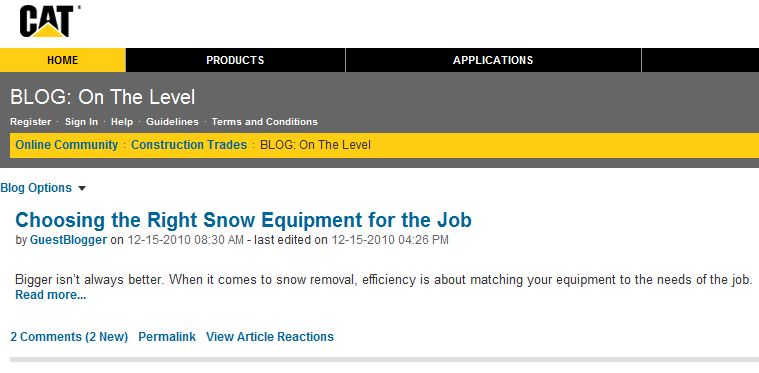
Goals: Problem-solving, community-building, loyalty
So you don’t think blogs have a place in the B2B world? Can’t imagine somebody from a road construction crew logging in to read a blog? Think again.
Caterpillar established separate blogs based on industry (construction, electrical, marine) with sub-categories under each industry (products, safety, problem-solving). This company does a wonderful job engaging customers, using the community to solve problems, and rewarding customer ideas.
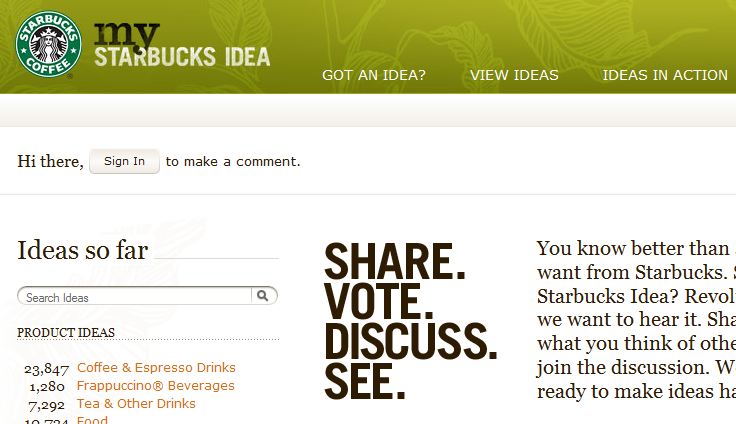
Goals: New product development, engagement
Well-managed companies usually excel at many things and Starbucks is no exception. They are leading the way in social media marketing but the unexpected aspect of their blog is that it only tangentially has anything to do with coffee. Instead, Starbucks employs its blog as a global brainstorming platform. Customers submit ideas for new drinks, food items, packages, even store designs. The company blogs about the ideas (about 100,000 so far!) and readers build on the ideas through comments and ratings. The idea is brilliant.
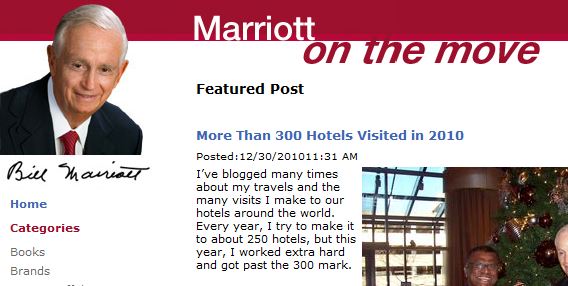
Goals: Customer satisfaction, sales, crisis management
Bill Marriott is one of the most famous corporate bloggers in the world. Yes, the company chairman actually does his own posts, dictating them on a weekly basis. This personal involvement has won the site loyal fans since they know they are getting the word from a real executive — a powerful point of differentiation. The company has reported generating millions in direct sales from this blog and has also used this as a platform to set the record straight in the event of a bombing or hostage situation involving one of their properties. Another “personal journal” blog I’ll submit as a runner-up in this category is Randy’s Journal from Boeing.

Goals: Direct sales, loyalty
In a hotly-competitive, low-margin business, this regional grocery chain is trying to stand out with a fun, easy-to-navigate site. The blog design changes every few weeks to reflect colorful seasonal themes. The company has managed to attract a loyal and engaged audience through posts from president Danny Wegman and other store employees on ideas for entertaining at home, recipes and nutrition. I saw one post where the deli chef was responding to questions by telling customers which aisle to find ingredients for some tasty muffins. I love the fun, down-home and authentic engagement on this site!
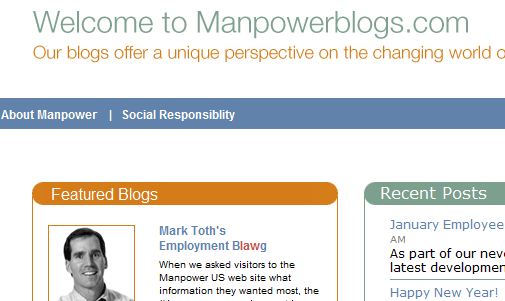
Goal: Thought leadership
Here’s how blogger Mark Toth describes the mission of the blog: “When we asked visitors to the Manpower US website what information they wanted most, the answer was employment law. This bLAWg is an attempt to meet that demand and engaging and educational content.” You mean they actually listened to customers and created a blog around their information needs? Seems like such a simple idea but unfortunately ignored by most companies.

Goal: Brand Awareness
When I use the GE blog as an example in my classes there is usually a comment like “Oh … I thought they were only lightbulbs.”
This blog is aimed squarely at breaking this image through wonderful story-telling. If you want to see a blog that is doing a good job spinning some entertaining stories, look no further. It’s not uncommon to see wonderful photography, video, and even art and music used in a blog post to illustrate a point. The one area that needs to be improved — I think they are trying to hit too many diverse customers with one blog. It’s time to segment with multiple blogs.

Goal: Customer engagement, brand awareness
How in the world do you create passion for scissors? Fiskars has done it in one of the most creative blogs in the corporate world. The company solicited help from four scrapbook fanatics who demonstrate their love of crafting — and the tools they use — with this customer-generated content. One of the greatest marketing applications for blogging I have seen.

Goal: Enhance corporate image and integrate with traditional media
This is one of the world’s best-known corporate blogs but I would be remiss if I didn’t include it here. People generally hate airlines but somehow Southwest has risen above this with a quirky, honest blog about travel and the people who make it happen. This is the anti-corporate-press-release blog. They also wisely use this as a way to connect with employees. Smart business.

Goal: Complement brand image, engage community
Patagonia is a company that sells high-end adventure gear and this no-frills site does a marvelous job featuring reader stories of what else … high-end adventure! You have to love a corporate blog that features a post called “Waking up puking.”
The magic of social media is finding a way to enable your customers to carry your brand promise through to their stories and this site is a best practice.

Goal: Complement brand image, direct sales
Like Starbucks and Zappos, Whole Foods is a social media darling, and for good reason. They do great work! This popular blog is full of how-to’s, best practices and exciting product ideas.
Of course it would be impossible for me — or anybody for that matter — to do a comprehensive evaluation of every corporate blog in the world but these are some that demonstrate the use of compelling content to align with tangible business objectives.
I would value your comments on these wonderfully diverse blogs. What company blogs should I consider for my next class? I’m especially interested in any small businesses that are effectively working the blogging channel.

 Take the Mystery Out of Twitter!
Take the Mystery Out of Twitter!
Become a Twitter Ninja in just 90 minutes with the The Tao of Twitter, the best-selling Twitter book in the world! Learn the three elements behind every Twitter success, 22 ways to build a relevant audience, strategies to create personal and business benefits, and hundreds of amazing tips and time-savers.
, the best-selling Twitter book in the world! Learn the three elements behind every Twitter success, 22 ways to build a relevant audience, strategies to create personal and business benefits, and hundreds of amazing tips and time-savers.
- See more at: http://www.businessesgrow.com/2011/01/05/the-10-best-corporate-blogs-in-the-world/#sthash.6mf9sx4u.dpuf
Subscribe to:
Comments (Atom)