Sunday, June 30, 2013

"The One Key Person Who Will Help Improve Your Sales"

This is part of a series that describes a sales methodology for technology companies or frankly many other types of companies, too.
This post is about finding your "champion."


We developed this at our first company and called it PUCCKA – the overall methodology is described here.

The first “C” stands for Compelling Event.
This post is about the second “C” or Champion.
No product sells itself no matter what startup companies like to think.
In order for an organization to buy product it takes an individual who has a budget and is willing spent it on you or they have access to a group budget and are willing to fight for the resources to implement your solution.
This is especially true for products that involve more than an individual user.
Every company is inundated with products and technology so inertia takes over. It’s far easier to do nothing than to do something new.
Not everybody who is nice or helpful to you is your "champion."
In order for somebody to be a champion they need to have both influence (in order to persuade others to take action) and “authority” to either make the decision or to get somebody who holds budget to make the decision.
I shorthand these two things – Influence and Authority – as IA.
I do this to contrast the opposite, which is NINA – no influence, no authority. Otherwise known as a time wasters.
In order for somebody with IA to be your champion he has to be actively helping you through the sales process. If he's not then he may simply be an IA but he may not be a champion. Or worse – he may be somebody else’s champion.
Of course you have to develop and nurture champions. Obviously they need to be bought into your solution and feel compelled that it will solve a problem in their organization (the PUC).
He or she also need to trust you, personally. In order to spend money or access budgets and especially if other people need to use this product she is going to have to stick her neck out to implement you.
Understanding why an individual would buy something or why she should champion you deserves reflection. Is she managing a P&L and wants to reduce costs or improve sales? Is she a mid-level in an exec and wants to be seen as an innovator by embracing new, exciting technologies?
Most people never try to understand the psychology of the buyer but I think it's tremendously important.
You need to find your champion and nurture the relationship.
Big deals that involve multiple people deciding seldom go your way without a champion so you need to be in search of yours to win the account and you need to constantly test whether somebody is your champion or not. But I’ll get to that in a moment.
The best kind of champions are what I call “egg breakers” and this again forms part of our sales teams shorthand nomenclature to figure out whether our process is going well as in, “OK, you said Susan is your champion, but is she an egg breaker?”
Egg breakers don’t mind making tough decisions. They’re willing to stick their necks out when others keep silent.
Imagine a room full of people who have convened a meeting to discuss whether to go ahead with your project (or maybe to select a vendor amongst many).
There might be somebody in the room who is most knowledgeable and/or most passionate about which solution to pick. But that person is irrelevant if he's not willing to defend his position strongly when others advocate harder for a different answer.
Other people are “consensus driven” even if they’re willing to assert their point-of-view in a meeting. They want to wait until everybody is bought in and until every bit of information is considered.
With this kind of person advocating on your behalf you run the risk of your decisions being over-turned and or the decision process to be elongated.
You want IA Egg Breakers as champions.
A champion is somebody rooting for you. They typically are willing to be transparent about the most important factors you need to know in a sales campaign
  • Who else is involved in the decision?
  • Who makes the ultimate decision or is it made by group vote?
  • Who is for you and who is against?
  • Who are you competing against?
  • Who holds the budget for this project?
  • When is a decision likely?
You can often test whether somebody is a champion or not by asking some of these questions and finding out whether they’re willing to be open with you about the process.
Not open = not a champion. Period.
If a person is holding back on you need to go in search of a champion in order to win the campaign. Just because this person isn't your champion doesn’t mean he's against you, just that you can’t count on him to push hard for you at the moment of truth.
You need that champion in the decision-making process and in the room when the topic is debated.
And remember that just because a person is friendly with you and shares the information above doesn’t make him a champion. It makes him really useful (for sure!) but not necessarily a champion.
Because a champion has influence and authority.
Even if you’ve identified your champion your work isn’t done.
There are often many players involved in a decision for or against you and you need to meet or speak with all of them to understand the purchasing landscape.
And that is the subject of my next post, “Key Players.”

Wednesday, June 26, 2013

"7 Reasons Why the Customer Should Be #1"

The customer is king. Believing otherwise will likely drive your business into the ground.

Here’s what I mean: Far too many businesses are stuck on perfecting their ideas, products, or services, when the real focal point should be pleasing the customer. Those businesses and brands who do cater solely to their user will always win in the end. But transforming your company to better serve your customers may not be as simple as it sounds.
To get more proactive insight on putting your customers first, I spoke with John Tabis, the founder and CEO of TheBouqs.com, an LA-based cut-to-order online flower delivery company. After recently receiving a $1.1 million seed round of funding, it’s clear their focus on improving the overall customer experience hasn’t gone unnoticed.
Here are a few tips from John to get you on the fast-track to putting your customers first:
1. Define and focus. Before your can begin to improve the overall experience for your customer, you must first understand who they are and what they really want. Toss out the idea of having a broad audience and hone in on the specific target market most relevant to your business. Research their basic interests, wants, and needs and begin transforming your business to better accommodate these aspects.
2. Keep it simple. If you’re really looking to stand out, simplicity will be your saving grace. Far too many businesses think their customers want fancy features and end up overbuilding their products to the point of no return. In reality, your customer craves a simplistic experience with no unnecessary features, “extras”, or gimmicks.
For example, Tabis knew a stealthy, no-nonsense ordering process mattered to the target audience of TheBouqs.com. They created a straightforward, honest, and simple way to purchase their product that involves one flat fee, only 40 bouquet options to choose from, no hidden fees, and just three clicks to checkout.
3. Tout your personality. Who says simple can’t be fun? Make your brand more memorable by injecting it with a level of personality. TheBouqs.com may have a simplified ordering process, but their website and online presence boast a youthful and engaging level of personality. From their bouquet names to their use of photography, one click-through of the website gives customers a taste of the energetic personality of their brand.
4. Find what’s missing in your market. This mixture includes equal parts of knowing what customers in the market want and understanding what your competitors aren’t doing right. By fixing this disconnect and filling a void, you’re not only going to stand out from your competition, but also have a chance at changing the market in the process.
In the flower industry, many businesses have completely forgotten about the buyer by throwing in hidden fees, spamming marketing materials, and trying to sell non-bouquet extras in the purchase process. TheBouqs.com got to the heart of this big market-related issue, which also positively transforms the customer experience as a whole.
5. Develop a pleasant experience. By making your customer’s interactions and experiences as efficient and effective as possible, you’re ensuring their return. Streamline interactions and processes to cut the fuss and put your customers at ease. This means providing fewer clicks at the point of purchase and keeping fees as transparent and standard as possible.
6. Show them respect. Giving your customers an unmatched experience is only possible through respecting their time and inbox. Don’t spam your customers with marketing materials or hit their inbox too often. Too many businesses believe this is a way to keep their customers “in the know” when it’s actually working to push them away. At TheBouqs.com, they send out one email a week. For your customer, twice a week or daily might be best. You need to customize your marketing to match your customers wants and needs.
7. Play to your user’s values. Sure, you may doing your best to give your customers what they want in terms of experience, but keying in on their values will show them you really care.For instance, TheBouqs.com knows their customers value social-responsibility. They built their business foundation on this value through partnering with eco-friendly, sustainable farms that respect the environment and their farmers.
When it comes to your customers, giving a little will get you a lot in the long run. Put your customers first and you’re sure to come out on top.
How do you put your customers first?

Sunday, June 23, 2013

"The 10 Best Corporate Blogs in the World"

My reaction to most company blogs: “Blah, Blah and Double Blah!”
I recently taught a class on corporate blogging at the amazing social media marketing graduate program at Rutgers University.  In my research for the class, I pored through hundreds of websites looking for examples of the best company blogs in the world.
Amid the coal pile that is the state of corporate blogging today, I did manage to find a few diamonds that don’t bore to tears with pronouncements, promotions and product announcements (the Killer P’s).
Before I provide my view of the best of the best, here are a few general observations about the state of corporate blogging:
1) The best blogs are dominated by the tech sector. In fact, they are so far ahead of the rest of the corporate world that I found it unfair to rank the professionals with the amateurs!  IBM, SAP and Oracleare examples of innovative and remarkable blogs. Nearly every hardware, software and services company “gets it.” I thought it would be more interesting here to focus only on the non-tech sector. I also excluded any reference to Zappos simply because I am sick of Zappos and it’s my blog dammit.
2) Corporate blogging has evolvedfar beyond the idea of personal journaling.  Think of any company goal and there is likely to be an example of a company blog supporting it.  You may be surprised at the diversity of blogs in these examples.
3) There is a chasm between the adoption of blogs at large companies versus the rest of the world.  The Center for Marketing Research at the University of Massachusetts showed in a study that just 22% of the Fortune 500’s blog compared to 45% of the Inc 500′s and about 80% of non-profits. And even when some companies claimed to have a blog, I couldn’t find it.  Corporate blogging is still a wide-open area for marketing channel development since there are so many proven benefits of blogging! And many of these blogs are U.S.-based because the adoption of corporate blogging is even lower in the rest of the world.
In no particular order, here are ten examples of exceptional non-high-tech blogs:

Goals: Problem-solving, community-building, loyalty
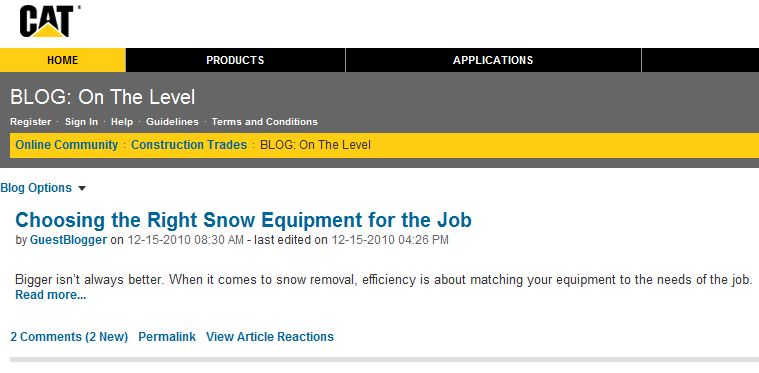
So you don’t think blogs have a place in the B2B world? Can’t imagine somebody from a road construction crew logging in to read a blog? Think again.
Caterpillar established separate blogs based on industry (construction, electrical, marine) with sub-categories under each industry (products, safety, problem-solving). This company does a wonderful job engaging customers, using the community to solve problems, and rewarding customer ideas.

Goals: New product development, engagement
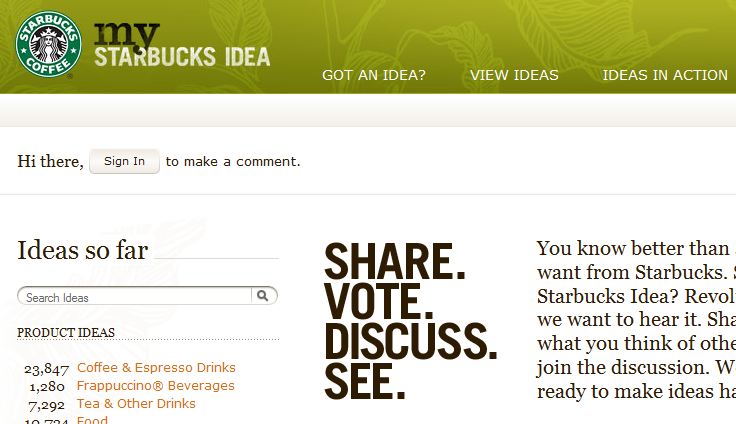
Well-managed companies usually excel at many things and Starbucks is no exception.  They are leading the way in social media marketing but the unexpected aspect of their blog is that it only tangentially has anything to do with coffee. Instead, Starbucks employs its blog as a global brainstorming platform.  Customers submit ideas for new drinks, food items, packages, even store designs. The company blogs about the ideas (about 100,000 so far!) and readers build on the ideas through comments and ratings. The idea is brilliant.

Goals: Customer satisfaction, sales, crisis management
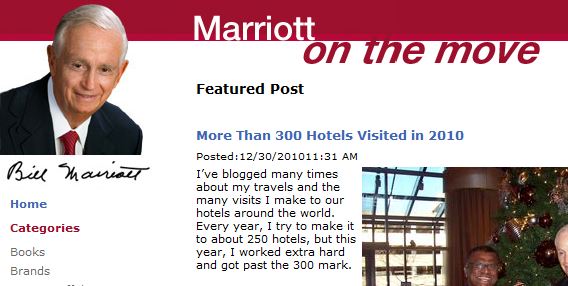
Bill Marriott is one of the most famous corporate bloggers in the world. Yes, the company chairman actually does his own posts, dictating them on a weekly basis. This personal involvement has won the site loyal fans since they know they are getting the word from a real executive — a powerful point of differentiation. The company has reported generating millions in direct sales from this blog and has also used this as a platform to set the record straight in the event of a bombing or hostage situation involving one of their properties. Another “personal journal” blog I’ll submit as a runner-up in this category is Randy’s Journal from Boeing.

Goals: Direct sales, loyalty
In a hotly-competitive, low-margin business, this regional grocery chain is trying to stand out with a fun, easy-to-navigate site. The blog design changes every few weeks to reflect colorful seasonal themes. The company has managed to attract a loyal and engaged audience through posts from president Danny Wegman and other store employees on ideas for entertaining at home, recipes and nutrition. I saw one post where the deli chef was responding to questions by telling customers which aisle to find ingredients for some tasty muffins. I love the fun, down-home and authentic engagement on this site!

Goal: Thought leadership
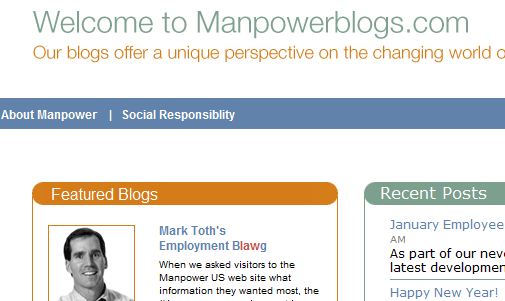
Here’s how blogger Mark Toth describes the mission of the blog: “When we asked visitors to the Manpower US website what information they wanted most, the answer was employment law. This bLAWg is an attempt to meet that demand and engaging and educational content.”  You mean they actually listened to customers and created a blog around their information needs?  Seems like such a simple idea but unfortunately ignored by most companies.

Goal: Brand Awareness
When I use the GE blog as an example in my classes there is usually a comment like “Oh … I thought they were only lightbulbs.”
This blog is aimed squarely at breaking this image through wonderful story-telling. If you want to see a blog that is doing a good job spinning some entertaining stories, look no further. It’s not uncommon to see wonderful photography, video, and even art and music used in a blog post to illustrate a point. The one area that needs to be improved — I think they are trying to hit too many diverse customers with one blog. It’s time to segment with multiple blogs.

Goal: Customer engagement, brand awareness
How in the world do you create passion for scissors?  Fiskars has done it in one of the most creative blogs in the corporate world. The company solicited help from four scrapbook fanatics who demonstrate their love of crafting — and the tools they use — with this customer-generated content. One of the greatest marketing applications for blogging I have seen.

Goal: Enhance corporate image and integrate with traditional media
This is one of the world’s best-known corporate blogs but I would be remiss if I didn’t include it here. People generally hate airlines but somehow Southwest has risen above this with a quirky, honest blog about travel and the people who make it happen. This is the anti-corporate-press-release blog. They also wisely use this as a way to connect with employees. Smart business.

Goal: Complement brand image, engage community
Patagonia is a company that sells high-end adventure gear and this no-frills site does a marvelous job featuring reader stories of what else … high-end adventure! You have to love a corporate blog that features a post called “Waking up puking.”
The magic of social media is finding a way to enable your customers to carry your brand promise through to their stories and this site is a best practice.

Goal: Complement brand image, direct sales
Like Starbucks and Zappos, Whole Foods is a social media darling, and for good reason. They do great work! This popular blog is full of how-to’s, best practices and exciting product ideas.
Of course it would be impossible for me — or anybody for that matter — to do a comprehensive evaluation of every corporate blog in the world but these are some that demonstrate the use of compelling content to align with tangible business objectives.
I would value your comments on these wonderfully diverse blogs.  What company blogs should I consider for my next class? I’m especially interested in any small businesses that are effectively working the blogging channel.

Take the Mystery Out of Twitter!

Become a Twitter Ninja in just 90 minutes with the The Tao of Twitter, the best-selling Twitter book in the world!  Learn the three elements behind every Twitter success, 22 ways to build a relevant audience, strategies to create personal and business benefits, and hundreds of amazing tips and time-savers.
- See more at: http://www.businessesgrow.com/2011/01/05/the-10-best-corporate-blogs-in-the-world/#sthash.6mf9sx4u.dpuf

Sunday, June 2, 2013

"8 Things Productive People Do During the Workday"

Forget about your job title or profession – everyone is looking for ways to be more productive at work. It’s time to set down your gallon-sized container of coffee, toss out your three-page to-do list, and put an end to those ridiculously long emails you’ve been sending.

Experiencing a highly productive workday can feel euphoric. But contrary to popular belief, simply checking tasks off your to-do list isn’t really an indication of productivity. Truly productive people aren’t focused on doing more things; this is actually the opposite of productivity. If you really want to be productive, you’ve got to make a point to do fewer things.
Recently I spoke with project management and productivity genius Tony Wong to find out the secret to a more productive workday. He provided me with some excellent insight into what he and other like-minded productive individuals do during their work week.
Harness your productivity by taking note of these eight things:
1. Create a smaller to-do list. Getting things accomplished during your workday shouldn’t be about doing as much as possible in the sanctioned eight hours. It may be hard to swallow, but there’s nothing productive about piling together a slew of tasks in the form of a checklist. Take a less-is-more approach to your to-do list by only focusing on accomplishing things that matter.
2. Take breaks. You know that ache that fills your brain when you’ve been powering through tasks for several hours? This is due to your brain using up glucose. Too many people mistake this for a good feeling, rather than a signal to take a break. Go take a walk, grab something to eat, workout, or meditate – give your brain some resting time. Achieve more productivity during your workday by making a point to regularly clear your head. You’ll come back recharged and ready to achieve greater efficiency.
3. Follow the 80/20 rule. Did you know that only 20 percent of what you do each day produces 80 percent of your results? Eliminate the things that don’t matter during your workday: they have a minimal effect on your overall productivity. For example, on a project, systematically remove tasks until you end up with the 20 percent that gets the 80 percent of results.
4. Start your day by focusing on yourself. If you begin your morning by checking your email, it allows others to dictate what you accomplish. Set yourself in the right direction by ignoring your emails and taking the morning to focus on yourself, eat a good breakfast, meditate, or read the news.
5. Take on harder tasks earlier in the day. Knock out your most challenging work when your brain is most fresh. Save your busy work – if you have any – for when your afternoon slump rolls in.
6. Pick up the phoneThe digital world has created poor communication habits. Email is a productivity killer and usually a distraction from tasks that actually matter. For example, people often copy multiple people on emails to get it off their plate – don't be a victim of this action. This distracts everyone else by creating noise against the tasks they’re trying to accomplish and is a sign of laziness. If you receive an email where many people are CC'd, do everyone a favor by BCCing them on your reply. If your email chain goes beyond two replies, it’s time to pick up the phone. Increase your productivity by scheduling a call.
7. Create a systemIf you know certain things are ruining your daily productivity, create a system for managing them. Do you check your emails throughout the day? Plan a morning, afternoon, and evening time slot for managing your email. Otherwise, you’ll get distracted from accomplishing more important goals throughout the day.
8. Don’t confuse productivity with laziness. While no one likes admitting it, sheer laziness is the No. 1 contributor to lost productivity. In fact, a number of time-saving methods – take meetings and emails for example – are actually just ways to get out of doing real work. Place your focus on doing the things that matter most as efficiently and effectively as possible.
Remember, less is more when it comes to being productive during the workday.